
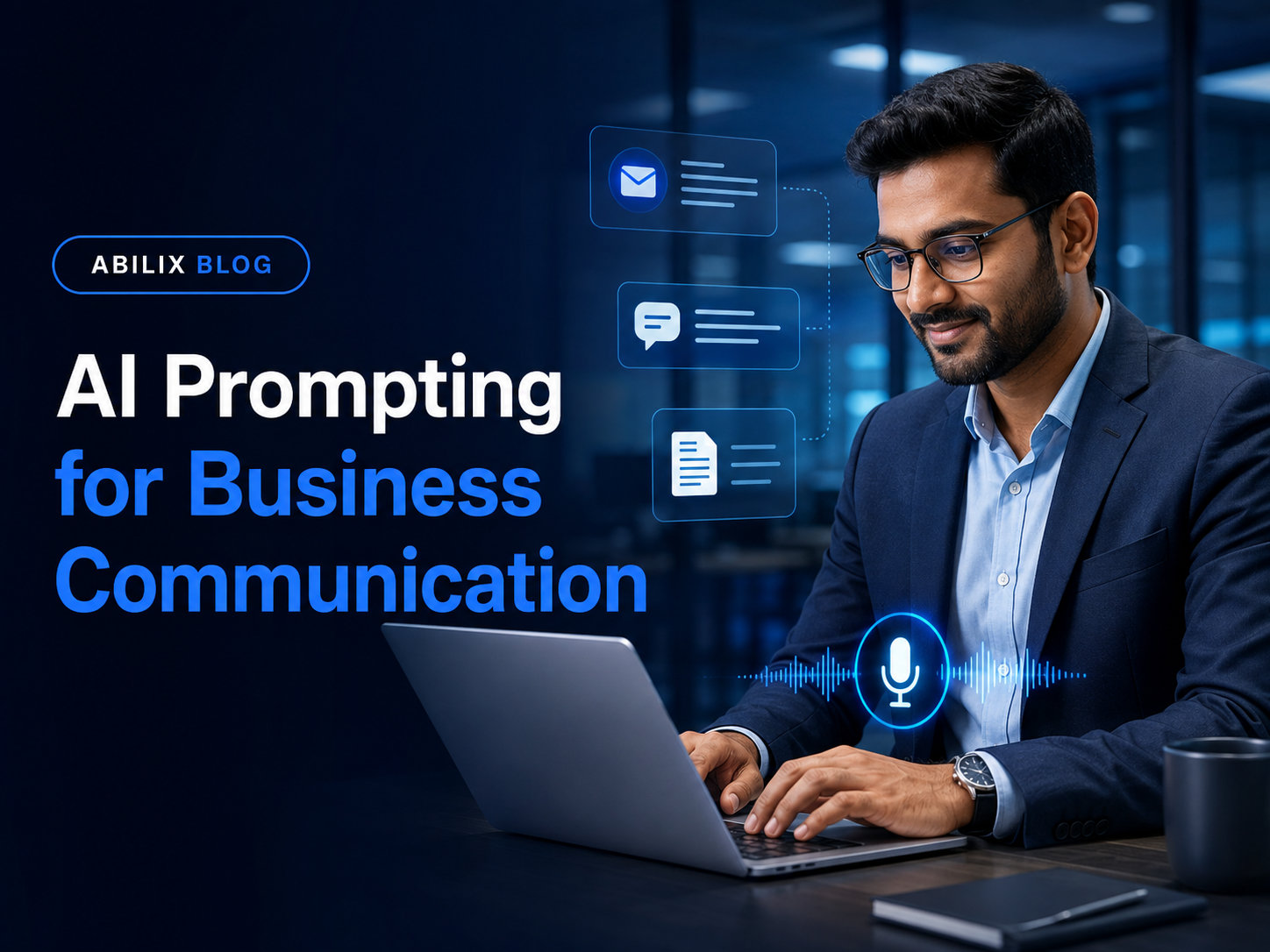
AI prompting helps professionals give clearer instructions to AI tools so business messages are more relevant, structured and easier to review.
AI can help teams draft emails, customer replies, proposals and reports, but the quality of the result depends heavily on the instruction. Good prompting is not about using complicated language. It is about giving the AI enough context, a clear task and useful boundaries.
A simple prompt framework
Use five elements when you write a business prompt:
- Role: explain who the AI should act as
- Context: describe the situation and audience
- Task: state the exact output you need
- Constraints: set tone, length, format and facts to avoid
- Review: ask for a checklist or alternatives before finalising
Example: improve a customer email
Instead of writing “reply to this customer,” try: “Act as a customer support manager. Draft a friendly 120-word reply to a customer whose delivery is two days late. Apologise without admitting unsupported facts, explain the next step and end with a clear contact option.”
This prompt reduces ambiguity and makes the output easier to review. You should still verify names, dates, prices and policy details before sending.
Where prompting adds value
- Summarising meeting notes into actions and owners
- Turning technical information into plain-language updates
- Creating first drafts of proposals and presentations
- Adapting one message for customers, staff or leadership
- Checking a document for clarity, tone and missing information
Use AI responsibly
Do not paste confidential, personal or commercially sensitive information into an AI service unless your organisation has approved the tool and data handling. Treat every response as a draft. A human remains responsible for accuracy, judgement and the final message.
For ready-to-use ideas, browse the Abilix prompt library.
Take the Next Step
Build practical prompting skills across your team with our AI training programs, or speak with Abilix about a tailored workshop.
A simple AI prompting framework
Effective AI prompting starts with four elements: context, task, format and constraints. Tell the tool who the message is for, what outcome you need, how the answer should be structured and which details must be included or avoided.
Draft a concise follow-up email for a potential CRM customer. Use a professional and helpful tone, summarise the two agreed requirements, propose a 20-minute call next week and avoid exaggerated claims.
This instruction is more useful than simply asking the tool to “write a sales email.” OpenAI’s official prompt-engineering guidance similarly recommends clear, specific instructions and iterative refinement.
Review before sending
- Confirm names, dates, prices and commitments against the original information.
- Remove confidential or unnecessary customer data.
- Check that the tone matches the relationship and communication channel.
- Replace generic wording with specific next steps.
Create reusable prompt standards
Teams can maintain approved prompt templates for common emails, proposals, meeting summaries and customer replies. A shared review checklist keeps quality consistent while allowing employees to adapt each message. Explore the Abilix prompt library for practical examples.
How to test a business prompt
Choose one recurring message and test the prompt against three realistic examples. Record whether the draft includes the correct facts, follows the required structure and needs major rewriting. If results vary, improve the instruction by adding a sample, a checklist or a clearer definition of the audience.
Do not judge a prompt only by how impressive one output looks. A useful business prompt should produce consistently reviewable work, help employees follow company standards and remain easy to update when the process changes. Assign an owner to maintain shared templates and remove versions that are no longer accurate.
Measure communication quality
Track the number of corrections, approval time, response speed and repeated customer questions. These measures reveal whether AI prompting is genuinely improving communication or only producing text faster. Review templates whenever products, policies, prices or customer expectations change.